


In November 2025, the Los Angeles City Council directed the Planning Department to develop a local alternative plan to blunt and delay the impacts of SB 79, the landmark housing bill signed into law last year by Governor Newsom. A lengthy report issued last week outlines exactly what will be required to achieve that goal.
Although the City of Los Angeles has well over 100 SB 79 transit oriented development zones centered on various bus and rail stops, further review by the Planning Department and its consultant Psomas has determined that the City could delay effectuation of the bill until 2030 for up to 88 percent of eligible sites citywide. In addition criteria such as potential impacts from climate change, location in a low-opportunity area, and historic preservation, TOD zones are also eligible for delayed implementation if at least 33 percent of sites within a zone permit half the density and floor area granted by SB 79, and the entire station area provides at least 75 percent of the capacity granted by the bill. As a result, the only transit hubs within the City of Los Angeles which are ineligible for delayed implementation are concentrated in the San Fernando Valley and the Westside. They include the G Line's stops at Tampa, Woodman, Valley College, Sepulveda, Reseda, Pierce College, Balboa; the E Line's Westwood/Rancho Park and Expo/Sepulveda Station, the Glendale Metrolink station, the K Line's Westchester/Veterans Station, and stops along the La Brea Avenue alignment of the K Line's proposed northern extension.
However. the City of Los Angeles may also be able to stall the implementation of the bill until 2030 citywide by upzoning certain areas. The Planning Department presents three options for doing so. Each option would involve permitting the redevelopment of single-family homes - something which was initially proposed, and later removed due to political pressure, from the Citywide Housing Incentive Program (CHIP), and focuses on all or part of a group of 55 "opportunity stations" located in census tracts designated as higher opportunity by the California Tax Credit Allocation Committee.
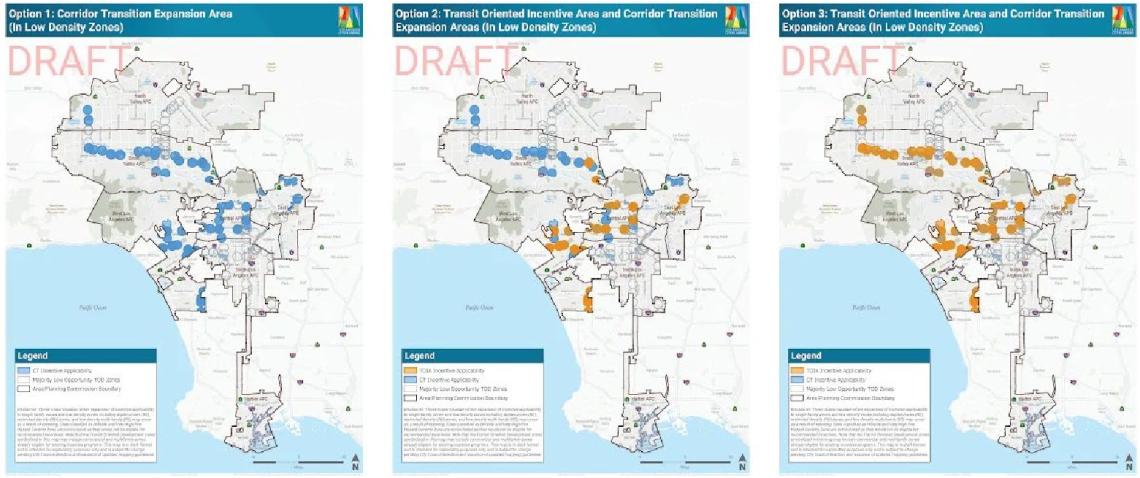 Potential upzoning options to delay citywide implementation of SB 79City of Los Angeles
Option 1: The City Council could approve an extension of the CHIP's Corridor Transition incentives to single-family and other low-density zones near 55 stations located in portions of Central and West Los Angeles, the South Valley, and parts of the Eastside. While this alternative would delay effectuation, additional rezoning would likely be required later on to comply with SB 79's regulations.
Option 2: In addition to the expansion proposed in Option 1, the City Council could also opt to expand the Transit Oriented Incentive Area benefits to sites near existing and operating rail lines, but not to sites near bus rapid transit stops or planned routes. This would result in higher intensity incentives near rail corridors in Central Los Angeles, and more modest incentives for sites in the South Valley, Northeast Los Angeles, and parts of the Westside.
Option 3: This alternative would pair Option 1 with an expansion of TOIA incentives to all single-family and lower-density parcels near all 5 opportunity station sites. It is the most aggressive of the three options offered by the Planning Department.
The incentives offered under the three options are as follows:
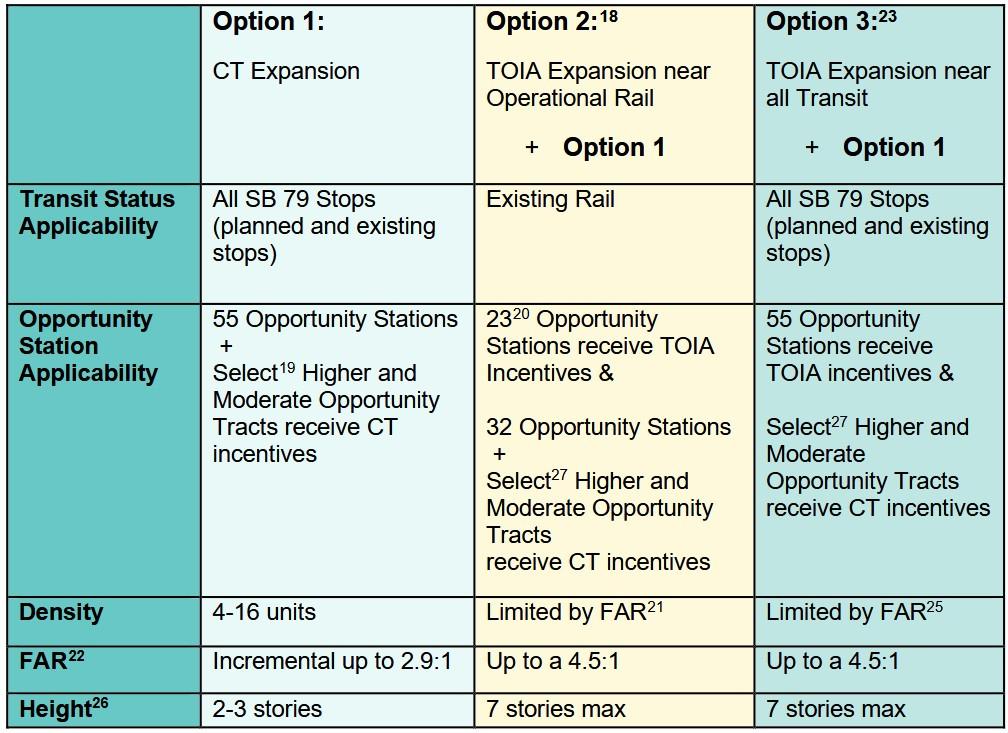 Incentives offered by the three optionsCity of Los Angeles
All three options would require approval of a code amendment by the City Council, as well as updated to the CHIP ordinance.
Los Angeles is one of many jurisdictions impacted by SB 79 which are struggling to digest exactly how the law would be implemented through a local alternative plan, including neighboring cities such as Beverly Hills. Acknowledging the impending Summer 2026 date for SB 79 to take effect, state legislators have recently expressed openness to delaying the deadline to grant jurisdictions more time, and have initiated legislation to that effect.
Follow us on social media:
Twitter / Facebook / LinkedIn / Threads / Instagram / BlueSky