



Tommy Beadel founded and served as the chief executive officer of Thomas James Homes, one of the largest urban, single-lot homebuilders in the United States. Since stepping down as CEO of Thomas James Homes in 2023, Tommy has pivoted to a new venture, HVN Development, which has rapidly emerged as perhaps the region's most prolific developer of income-restricted affordable housing. To get a look behind the curtain at the projects that so frequently appear in Urbanize, we recently sat down to speak with Tommy about this new venture.
This interview has been edited for length and clarity.
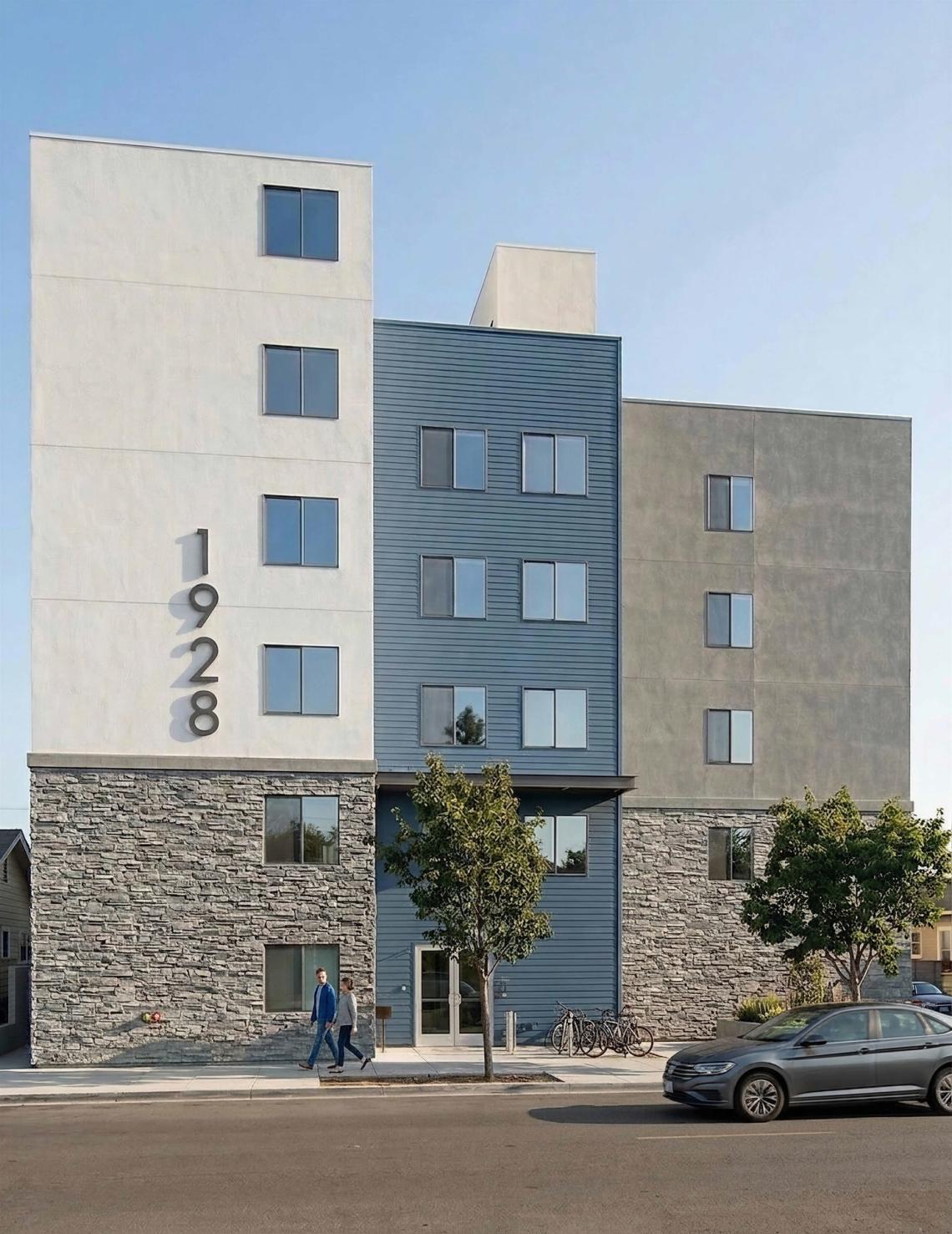 Rendering of 1928 S. Federal AvenueStockton Architects
Tell me about how you went from building single-family homes to affordable housing.
When I stepped down as CEO of Thomas James Homes and was looking at what to do next, I knew I did not want to start another home-building company. I've done that once, and I still sit on the board of Thomas James. But I wanted to take what I had learned at Thomas James about the City of Los Angeles - the by-right nature of development - and apply it to multifamily housing. To me it was was the same thing: how do we get access to the great neighborhoods, but serve a completely different segment of the market. At the time, I was evaluating all the opportunities through the state laws that have been changed, like AB 2334 and AB 2097, which eliminated parking requirements near transit. People talk a lot about the Mayor's Executive Directive 1, which has now been codified through the citywide housing incentive ordinance, but it is really AB 2334 that changed density bonus law and that allows unlimited density and three stories of extra height if you build housing for people at 80 percent of the area median income level. The City of Los Angeles has made it easy to utilize those state laws, and I saw an opportunity to build multi-family housing.
I would tell you that I've always looked to make an impact. I started HVN to bring the access of affordable housing to high-resource neighborhoods where people want to educate their kids and where people work. With Thomas James, we were doing hundreds of millions of dollars work on an annual basis, providing jobs and stimulating the economy. I still get to do all the same benefits, except now we provide not just benefit to one homeowner, but to hundreds of tenants who don't have the ability to otherwise move to a high-resource neighborhood because of the cost of living. We also get to impact homeowners with functionally obsolete real estate that has reached the end of its useful life.
I've kind of put two-and-two together watching the filings roll in, but what is it that you're looking for in a site? High-opportunity neighborhoods with single-family homes on land zoned for more?
Yeah. What we're looking for is where land is underutilized. The example I always give is in Mar Vista. Thomas James built more homes in Mar Vista than I think any other zip code in the City of L.A. And if you had two houses side-by-side that were both sitting on a 6,000 square foot lot, and one was 800 square feet and one was 1,500 square feet, the houses are worth different amounts of money because of the square footage of the improvements on the lot. But the 6,000 square feet of land sitting underneath it is worth the same, and so we would never have bought the 1,500-square-foot house. We always buy the 800-square-foot house that needs to be torn down. So it's really where is the land underutilized for what it is. With HVN, we're doing the same thing. Buying parcels with multifamily zoning in high-resource neighborhoods with proximity to major transit corridors.
To back things up a bit, I think the City of Los Angeles is the easiest place to develop real estate, which is a big statement. And mind you, I build real estate in 47 municipalities across the West Coast. Thomas James builds in L.A., Culver City, Santa Monica, and other jurisdictions in L.A. County. We build in multiple cities in Orange County, Silicon Valley, Seattle, Bellevue, and Kirkland. We built in and out of Denver, in Scottsdale, Phoenix, and so on. I have worked in a lot of jurisdictions developing housing, and I can tell you, I like the City of L.A. best. I think it's the easiest place to develop real estate, and I think that's a very contrarian view. The reason is that it is the largest single jurisdiction on the West Coast that is covered by one set of rules, and a very clear set of rules. When we go to Silicon Valley or Orange County, each municipality has a different building code and set of rules, and doesn't make up half the land mass of the City of Los Angeles. When you have a very clear set of rules, it makes it easy to develop, and I love the rules because I can follow them. I built Thomas James on a by-right entitlement path, and I built HVN development on a by-right entitlement path. When you follow the rules, nobody can slow you down or change what you're doing.
 Rendering of 5640 Riverton AvenueStockton Architects
There are places in Los Angeles with multiple specific plans and overlays, which complicate those rules. Do you steer clear of sites like that?
Yes. About 15 years ago, an investor asked me "Well, what do you do if there's a specific plan or a homeowners association?" We don't buy it. We only do by-right entitlements with a clear set of rules that there is no subjectivity to. It is the best. Having looked at how other jurisdictions function, if you can stay out of Planning, it is actually quite straightforward.
People say that the City of L.A., that getting power is hard - but that's not just in the City of L.A. What is not easy to deal with is uncertainty. In development, there's always uncertainty in terms of timelines and what you're going to develop, but that exists everywhere. What is not comfortable is uncertainty of "Can I build what I want to build, design it the way I want to design it, and get the density that I want on the property?". That predictability in the City of Los Angeles is why it's so easy to do.
With Thomas James, the homes are something of a kit of parts. I notice that HVN Development always makes use of the same entitlement and design team. How much of the ethos behind the two companies is the same?
We like predictability, and we have a winning formula that we know works. We know what tenants want, and we spend time improving the design of every single project to make sure. But I would tell you that we have four floor plans - two one-bedroom floor plans, and two two-bedroom floor plans. We mix and match those floor plans into a building. We build slab on grade and five stories of wood on top of it, and we fit as many of those four floor plans that we can into a building. And that's the magic. We know exactly what those units cost us to build, because we build them the same way every single time. There's no need for a crazy rooftop deck in one project or a fancy architect in another, because that's not predictable. And what's predictable is when you do the same thing over and over - we currently have 2,600 units in development in the City of Los Angeles, consisting of...
...Is that what your pipeline looks like now? I've honestly lost count over the past few years.
I think we have 36 projects in total in the process, whether that's under construction, in permitting, entitlements, or due diligence.
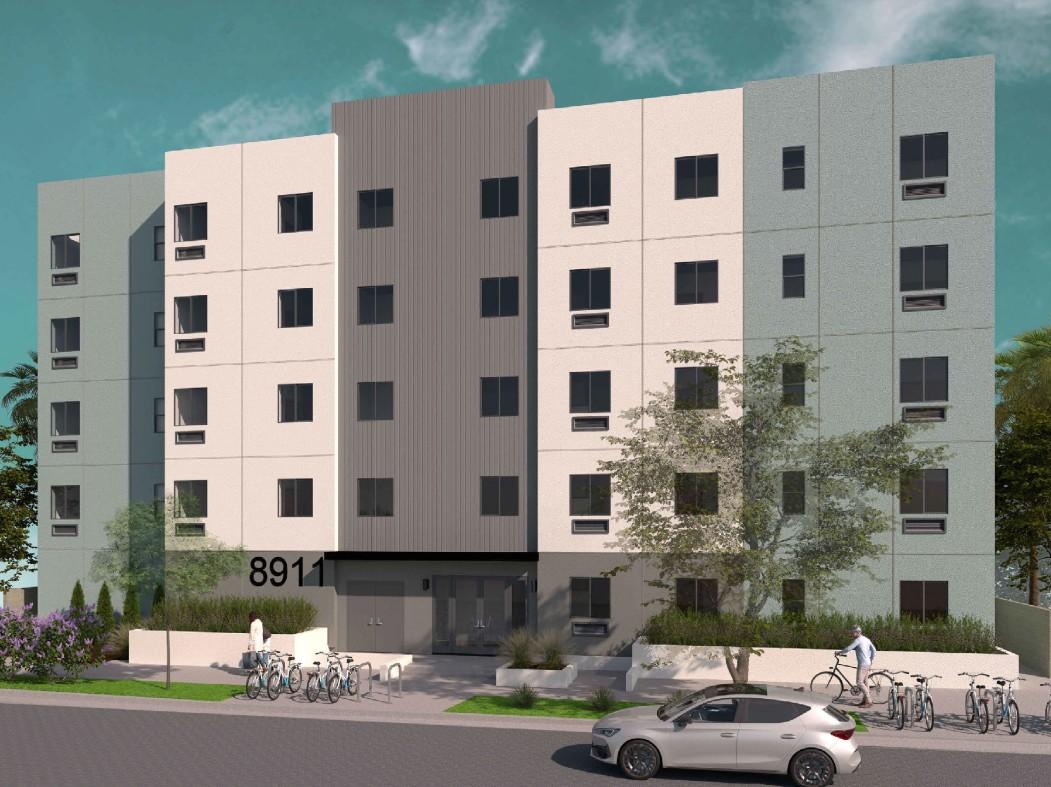 Rendering of 8911 Ramsgate AvenueStockton Architects
You mentioned that Thomas James works in many jurisdictions. Does HVN look outside of Los Angeles?
We develop in the City of Los Angeles. We are an affordable housing development and ownership company, so we develop and build new construction in the City of Los Angeles, but we buy affordable housing across the state.
So while many builders in Los Angeles are understandably concerned about the impacts of Measure ULA, that isn't a factor for you?
It's not. We develop to build a pipeline of properties to own and manage for the long term. We're not a merchant builder. We develop to own, and we capitalize the deals as such. So we're not worried about ULA.
I recently noticed some items on a City Council agenda about tax credit financing for some of your projects. How do you finance your deals, and has it changed at all?
We use multiple sources of capital for financing. We're active in the low-income housing tax credits. We also pair public financing with private investment, because every affordable housing project has a gap or need of private funds, rather than leveraging and using City of Los Angeles and their affordable housing funds.
Have the recent changes to land use regulations like the Citywide Housing Incentives changed the way you approach these projects.
We use the Affordable Housing Incentive Program, but everything is rooted in state density bonus law.
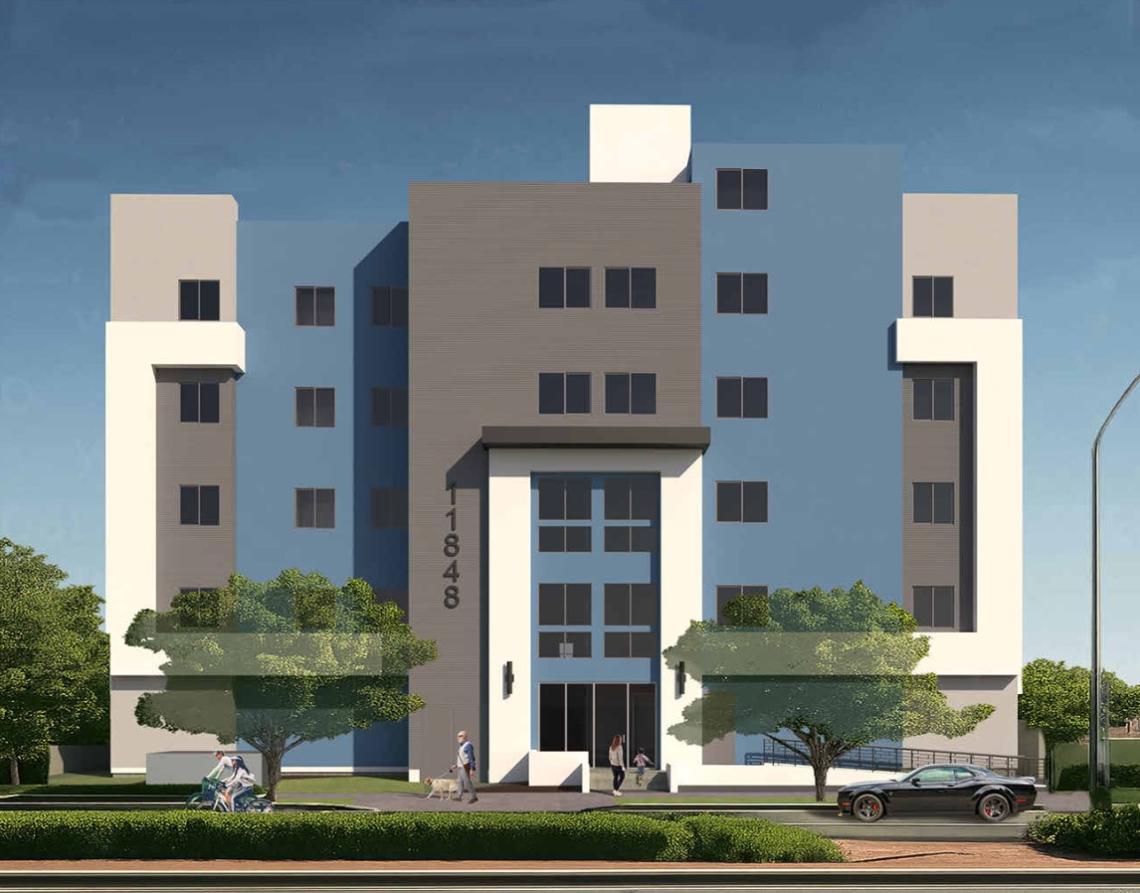 Rendering of 11848 Venice BoulevardStockton Architects
I was recently forwarded a community notice about a meeting regarding one of your projects in the Valley. You guys use the Enhanced Administrative Review (EAR) process, which does not require a hearing and results in an un-appealable approval letter, but what type of pushback have you faced from neighbors?
I think development always receives pushback. But we want to make an impact in developing housing under a clear set of rules. Not everyone is thrilled with the set of rules when they realize what they are, but the City of Los Angeles and State of California have incentivized the development of housing in these high-resource neighborhoods without parking, and they did that so we can solve our housing crisis. We're missing 489,000 units in the City of L.A., and the state has given us tools to solve the problem, so we're using those tools.
For example, we're developing a 75-unit building near the Costco on the Westside. We're bringing 75 one-bedroom affordable units. The project is funded by tax credits, so the average income is not 80 percent of AMI, but 60 percent of AMI. We have a mix of 30s, 50s, 70s, and 70s in that project, for an average of 60 percent. So we'll rent one-bedroom apartments for roughly $1,600 per month on average. It is seven blocks away from that Costco. There are 534 employees that work in that Costco, with an average wage of $26 per hour - that's about $50,000 to $55,000 per year. You can't live on the Westside in a one-bedroom apartments on $55,000. So in meeting with some of the management and employees of that store, we hear that people are commuting in from places like Palmdale, spending two hours in the car every day to get to work to support people who live on the Westside. They drive to these locations because that's where the work center is, and that's why we need housing in these locations. We want people to have access to these neighborhoods so they don't have to drive two hours. We can't impact all 534 employees at that Costco. People have family in other locations, own homes, and what have you. But we need to provide an opportunity.
People seem to have a negative view of affordable housing - I like to think we're building workforce housing for people that are fixing cars, bagging groceries, making coffee, and doing nails.
Final thoughts?
We watch every one of our projects published on Urbanize, and we get a lot of attention. But I think this is the other side of the story of what happens - how these projects get started, who is building them, why are they building them. I'll leave you with this: last year, I think 8,100 housing units were permitted and developed in the City of Los Angeles. HVN permitted 730 of those units. So we're close to 10 percent of the units built last year in the City of Los Angeles.
I think Mayor Bass provided a great opportunity [through ED1] with a clear path of entitlement, and I don't think she ever assumed that the private sector would come in and take it. We use the rules that exist, pair the capital that is available to us in the market with those rules, and have the ability to develop housing.