
Hilgard Economics is out with the latest edition of its Regional Pulse report for the third quarter of 2026, finding that housing permitting continues to rebound from the prior year.
Through September 2026, the City of Los Angeles has permitted 12,720 new housing units - a 123 percent increase relative to the meager 5,705 units permitted during 2025, when the City was hampered by the recent wildfires. In the third quarter, Los Angeles saw 3,864 new homes approved, which is a 50.8 increase over the same period in 2025.
The unique circumstances of fire recovery make a comparison of current figures to years past difficult, according to Hilgard Economics founder Joshua Baum, who points out that much of the new construction represents replacement structures for those lost during the disaster.
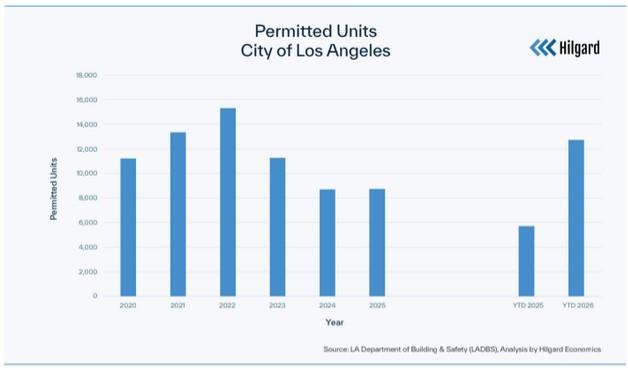 Residential permitting in Los Angeles from January to September 2026Hilgard Economics
Either way, an uptick in housing construction is a bright spot for what is an overall less rosy economic picture for the region. Los Angeles County added just 20,300 jobs through the third quarter, most of which were in health services and education. While the overall unemployment rate for the County was down to 4.5 percent relative to 5.9 percent one year early, this reduction was accompanied by a contraction in the labor force by 94,300 people. The government, manufacturing, and professional services sectors all saw job losses.
Likewise, while residential construction is recovering and home prices remain high, the County's office market continued to struggle, with an overall vacancy rate of 23.2 percent. While the Downtown market's struggles are well known, vacancies also exceed 20 percent in the Mid-Wilshire and West Los Angeles submarkets.
As has been well-reported, Hilgard found that film and television production continues to struggle, with total shoot days down 4.8 percent year-over-year. While there were gains in television comedy and feature films, losses in other areas offset those improvements. Local officials have placed their hopes in improved tax credits at both the state and federal level to stem the decline.
"Looking ahead, the county’s outlook will depend on whether growth extends beyond education and health services and generates stronger employment opportunities across the economy," writes Baum. "Labor force trends, housing completions, office leasing and absorption, and entertainment production will be important indicators to watch during the final quarter of 2026 and into 2027. Interest rates, inflation, consumer spending, travel costs, and geopolitical developments will also influence household finances and business investment."
Follow us on social media:
Twitter / Facebook / LinkedIn / Threads / Instagram / Bluesky