

At its March 25 meeting, Metro's board of directors voted to select the San Vicente - Fairfax alignment as the locally preferred alternative for a planned extension of the K Line to Hollywood.
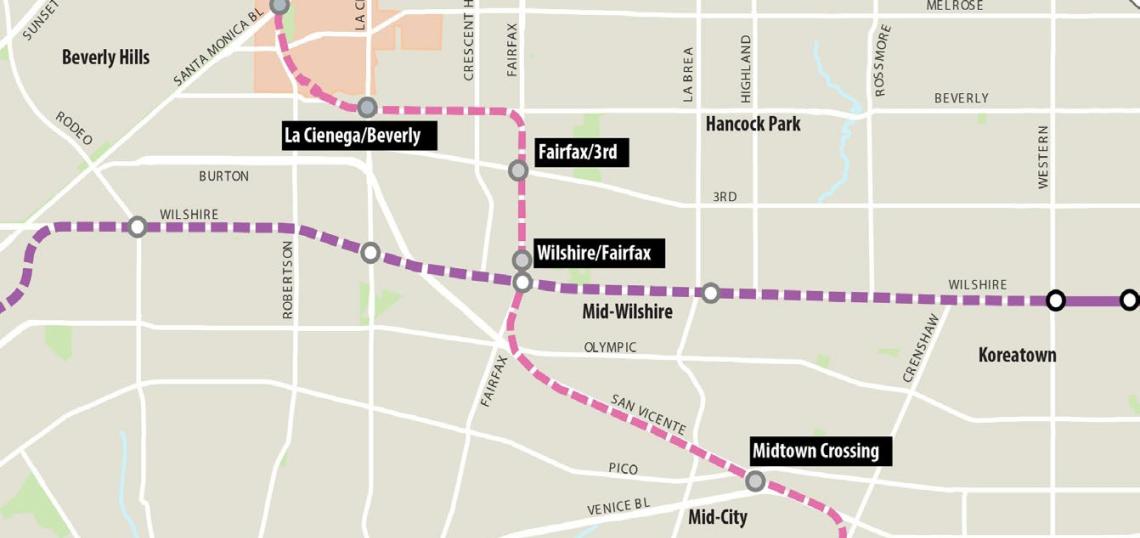
At 9.7 miles in length, the chosen route is the longest of the three which Metro had considered. Plans call for a 9.7-mile corridor running along segments of Crenshaw Boulevard, San Vicente Boulevard, Fairfax Avenue, Beverly Boulevard, Santa Monica Boulevard, and Highland Avenue. The project would include up to 10 new stations, including stops at Crenshaw/Adams, Midtown Crossing, Wilshire/Fairfax, Fairfax/3rd, La Cienega/Beverly, San Vicente/Santa Monica, Fairfax/Santa Monica, Santa Monica/La Brea, Hollywood/Highland, and potentially the Hollywood Bowl.
The meandering route would hit numerous major activity centers, including West Hollywood's commercial core, Cedars-Sinai Medical Center, The Grove, and Museum Row on the Miracle Mile. Likewise, passengers could transfer to the D Line at Wilshire/Fairfax or the B Line at Hollywood/Highland. Accordingly, Metro projects upwards of 60,000 riders on this corridor, with an estimated end-to-end trip of approximately 20 minutes. Much of that ridership is concentrated on transfer points to the B and D Lines, while the optional Hollywood Bowl Station would attract an estimated 300 daily trips.
The approximately cost of the project was previously estimated at approximately $14.8 billion, versus roughly $2.23 billion available in local tax revenues. Under initial plans, construction was projected to occur between 2041 and 2047. However, the City of West Hollywood, which lobbied heavily for the chosen alignment, has pledged billions toward the K Line extension's construction, potentially allowing work to commence years earlier.
West Hollywood intends to raise money for construction through the formation of an enhanced infrastructure financing district (EIFD), by which tax increment financing for land within the project's near vicinity could go toward the K Line's cost. Past reports have indicated that such a financing mechanism centered on the K Line could raise as much as $22 billion. However, the use of an EIFD to fund construction nearly proved to be a vulnerability during recent events which threatened to delay the project.
Residents of Lafayette Square and Wellington Square near the southern leg of the extension have fought plans to tunnel below their neighborhoods, arguing that such a structure could impact safety and property values. The issue has already resulted in an 18-month delay to the project to allow Metro to technical studies regarding the proposed tunnels. Los Angeles Mayor Karen Bass was reportedly inclined to push back a final decision on the route of a portion of the initial operating segment to allow for additional studies. However, as an EIFD for the K Line could not be formed without a formally chosen alignment, this would have delayed construction. The Metro board eventually voted to move the project forward, and merely conduct additional studies regarding tunneling impacts.
Follow us on social media:
Twitter / Facebook / LinkedIn / Threads / Instagram / Bluesky
- K Line (Urbanize LA)