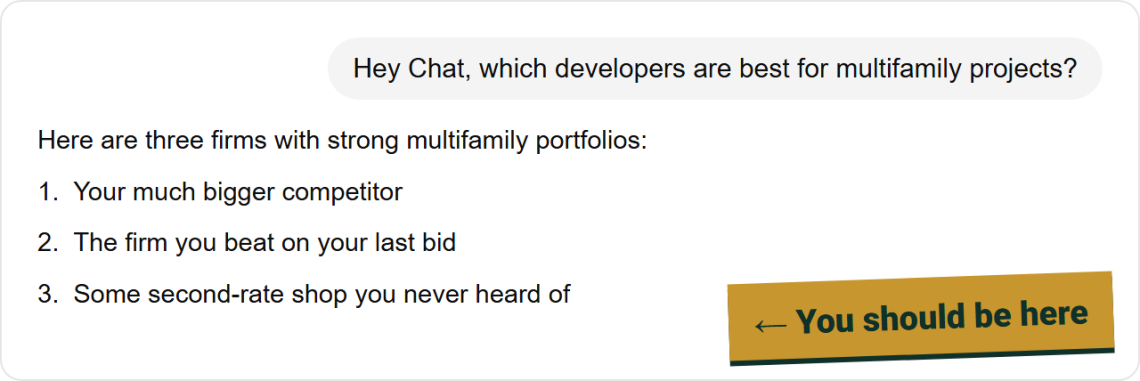
Buyers are asking AI chatbots questions like these about your services.
Imagine a developer needs to find an architect for a 200-unit project. A few years ago, the search would have started with Google. Today, it starts with a question posed to ChatGPT or Claude: “Which architecture firms are best for mid-size multifamily?”
A few seconds later, the developer has a shortlist of three to four names, each with a sentence explaining why they’re a good fit. He’s ready to hire, and he never even visited Google.
With this in mind, what’s the difference between traditional and AI search? How do chatbots even decide who to recommend in their answers? And what can you do about it?
Convenience is always king
If you think most people still use Google before ChatGPT, guess again. ChatGPT has more than 1.2 billion weekly users, according to OpenAI. Gemini has around 1 billion monthly users, while Claude and Perplexity boast 245 million and 100 million monthly users, respectively.
Additionally, Pew Research Center and Ahrefs found that when an AI summary appears at the top of search results, searchers are 50–58% less likely to click on the “blue link” results below it. There isn’t as much overlap as you’d think, either: only 12% of the links cited by ChatGPT, Gemini, and Copilot rank in Google's top 10 for the same question.
So, while strong search engine optimization (SEO) helps, it doesn't guarantee AI will name you. You’re still hitting a moving ball with a bat, but answer engine optimization (AEO) and generative engine optimization (GEO) are a different ballgame.
Worse, the gap between traditional and AI search only widens when you zoom out to broader online buyer behaviors.
- In Forrester's latest buyer survey, twice as many respondents named generative AI as their most meaningful source of information.
- In a G2 survey, 51% said they now start research in an AI chatbot more often than in Google, up from 29% a year earlier. 69% said a chatbot steered them to a different vendor, and 1 in 3 bought from a vendor they'd never even heard of.
- 6sense found that 94% of B2B buyers use AI chatbots at some point in their buying process, before making a decision.
Ask a question. Any question. You get a concise answer with direct links. It’s the original vision of Ask Jeeves, perfected. What’s not to like? Why would anyone still use Google first?
What real estate firms need to know
Zooming back down to the real estate sector specifically, recent findings are only corroborating the larger, national trend of AI search > Google search:
- Bisnow reports that nationwide, CRE investors are asking AI to recommend brokers. One LA broker they interviewed estimates 10% of his business comes from ChatGPT.
- Dealpath found that 71% of institutional commercial real estate professionals use assistants like ChatGPT directly.
- Zillow and Veterans United found that 45-50% of prospective buyers use AI tools in their home search, up from 37% a year earlier.
The numbers really do speak for themselves. The shift from traditional to AI search is only accelerating. These days, the firms that show up in AI answers get all the calls, and real estate is no exception.
How AI decides who to name
AI assistants like ChatGPT and Claude don't keep a fixed ranking of firms that they reach for when asked. Rather, each time someone asks a question, the AI gathers what it can find and trust in real time, then writes a detailed answer specific to that user’s query.
This means it’s never too late to start improving your AI search visibility (and right now, everyone is still pretty early). Every single query is a new chance to appear in AI answers. In terms of how to show up in AI search more often, a few key factors seem to matter most:
Specific, checkable facts. AIs favor pages that answer a question directly, with numbers they can repeat: units delivered, square feet, loan sizes, markets, years in business, named projects. In a Princeton study, expert quotes and statistics lifted visibility in AI answers by up to 40%.
High question coverage. Your target buyers have key questions (and sub-questions) they are likely to ask. Mapping out the full set of relevant questions and creating quality content that answers them (i.e., at least one answer article per question) is what AI likes to see and cite.
Consistency across sites. If your website, LinkedIn page, directory listings, and press coverage all describe you or your firm a bit differently, the engine has less basis for factual confidence and will be less likely to name you.
What others say about you. Profound's analysis of 680 million citations found Wikipedia makes up nearly half of ChatGPT's 10 most-cited sources, while Reddit accounts for nearly half of Perplexity's top 10 sources. Semrush found LinkedIn content was referenced in 11% of AI responses. Trade press, association pages, directories, and press releases also count.
What this means for your firm
Architects, designers, and engineers. Your portfolio is your proof, but AI can't read a gallery of renderings. Pair each project with facts: type, size, client, and the problem you solved.
Contractors and trades. Developers vet general contractors and subs by specialty and track record. Project pages and coverage of completed work carry more weight than a list of services.
Developers, owners, and operators. Investors, municipalities, brokers, and residents are all asking AI about you. Make sure your track record lives on pages the engines can read.
Lenders, banks and investors. Sponsors ask AI who lends on their deal type and size. If your programs, loan ranges, and closings aren't public, you can bet your competition is showing up.
Products, equipment, and proptech. Buyers compare vendors the same way software buyers already do. AI likes to cite comparisons, specs, and case studies with numbers.
Brokers and advisors. Clients ask AI who knows a property type or market. Named experts with published market views and thought leadership give the LLMs someone specific to point to.
5 things any firm can do this quarter
If you don’t believe me, or want to try this out yourself, you can and absolutely should. Here’s how to improve your AI search visibility, no matter what your firm does:
- Ask the AIs yourself. Type key questions your leads and clients would ask into ChatGPT, Claude, Gemini, and Perplexity. Ask each more than once to account for variability.
- Put real numbers on your key pages. Projects, volumes, sizes, timelines, and clients, written in plain text rather than locked in images or PDFs.
- Name your experts. Give your principals real bios and bylines, and let them publish what they know, and always include quotes, facts, and figures.
- Get covered where AI reads. Trade publications, industry associations, and directories carry weight with the engines. So do Wikipedia, LinkedIn, and Reddit.
- Make sure your facts match. Your website, LinkedIn, Google Business Profile, directory listings, and press bios should all tell the same story. Outdated info doesn’t help.
Get your free AI visibility report
Of course, you could do all this yourself. It would take a lot of elbow grease (and expertise) to do it correctly, at scale, and without AI slop damaging your visibility.
Or you could just let us do it for you. We run 10 of the top questions your buyers actually ask through four major AI engines, then send you a free report that includes:
- Your visibility score: How often your firm shows up in AI answers for all tested questions.
- Who's named instead: Which competitors AI recommends instead, how often, and why.
- Verbatim answers: The data includes every answer, verbatim, across all AIs consulted.
- Sources consulted: The websites and articles major AI chatbots read before they answer.
- Recommendations: Low-hanging-fruit fixes to improve your AI search visibility.
If your score is low, we can fix that. Or we can build the system and train your team to run it. Either way, all we need to get started is your website URL.
Get My Free AI Visibility Report
Why work with us? (case study)
AEO/GEO agencies have sprung up like daisies since Claude Code became a thing. They might talk a good game, but most have very limited (if any) experience doing what they claim.
Meanwhile, we cut our teeth at Madison Ave creative agencies and helped our clients corner SEO long before AI was a thing. Tailored Ink has worked with 200+ brands, including:
Case study: We helped architect and build CRE Daily from the ground up, and started with no website or brand. Within a few years, it reached 100,000+ subscribers and $1 million a year in sponsor revenues from the newsletter alone. Monthly site visits grew from under 500 to 61,162 in 8 months. By June 2025, CRE Daily showed up in Google AI Overviews for 468 keywords.